


Written by Wild Yak Expeditions
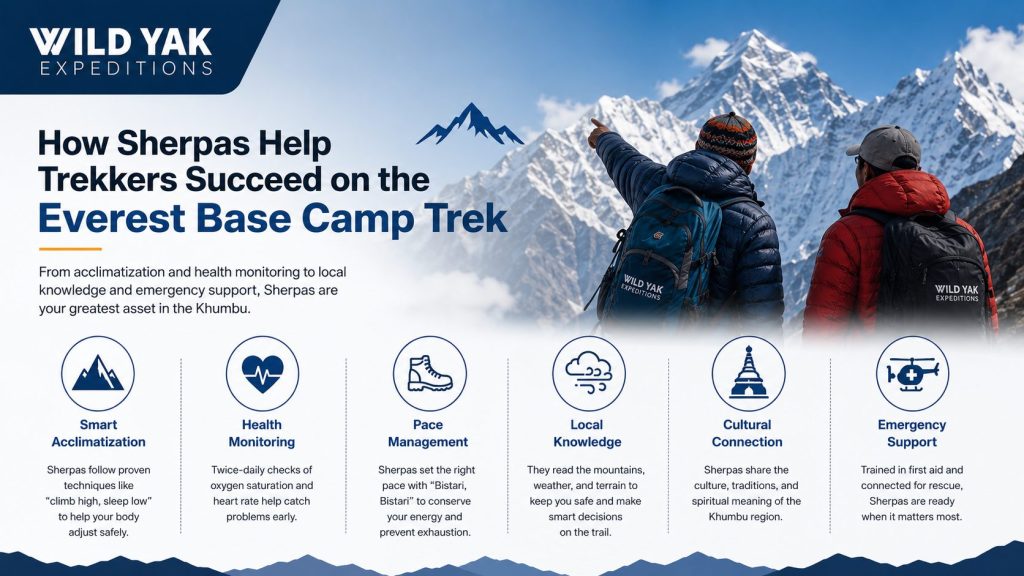
A successful journey to Base Camp comes down to the Sherpa guiding your steps. Their deep mountain literacy and patience are irreplaceable assets on the trail. When you are dealing with extreme elevation and the raw realities of the Khumbu valley, their real-time decision-making is what actually bridges the gap between turning back and making it to the top. This article will talk about Everst Base Camp Sherpa Guide and what it takes to succeed.
Situated at 5364 m, EBC is the core of the Khumbu region; it is not just a trek but a grueling, exhausting, and deeply psychological battle that one should win with a proper plan and implementation. Even though the trekker spends their money and months buying the expensive gear and hitting the stairmaster, the success boils down to one significant factor: the guide team, especially the Sherpa guide. Wild Yak Expeditions’ Sherpa guide focuses not only on the successful trek but also on the safe return of trekkers.
- Expert Acclimatization Guidance
It is not the steep trails or the distance that make the EBC trek difficult; it is the air shifting that makes it unpredictable. Oxygen availability at Everest Base Camp is approximately 50–55% of what is available at sea level. Hurrying up to complete the trek without a proper plan may cause acute mountain sickness (AMS) and ruin the whole journey before even taking a glimpse of the peaks.
A trekker should prioritize the experience rather than the cost, because sometimes chasing money can ruin the real experience. A rigid day-to-day schedule may not be practical for everyone, as their health may not align with that routine. Here comes the importance of an experienced Sherpa, because they are capable of changing the schedule according to the trekker’s body reaction; they have a solution for adjustment, not delaying for long, but preparing for the best.
The itineraries include the essential rest stops at Namche Bazaar (3,440m) and Dingboche (4,410m). Resting days are usually taken so that the trekkers can adapt to the physical changes. They follow the old mountaineering principles of “climb high, sleep low.” They will lead you through particular slow day hikes to higher ridges, such as Nangkartshang peak, where they will ensure your body is stimulated to create more red blood cells. This is the safest method of acclimatizing the body to the altitude, which is always controlled and constant.
- Reading Your Body Before You Do
At high altitudes, dangerous health changes happen quietly behind the scenes. Long before a trekker admits they are struggling, their body is signaling for help. This is where a Sherpa’s medical training and sharp intuition come into play.
Every single morning and evening, our team runs formal health checks. They use pulse oximeters to look at your blood oxygen saturation (SpO₂) and check your resting heart rate. They aren’t just glancing at a number; they are tracking your specific baseline from the moment you land in Lukla.
But data only tells half the story. A true Sherpa guide reads your behavior. Many trekkers are afraid to talk about discomfort or sickness because of the fear of returning with an incomplete journey. So, this is important for guides to:
- Notice a sudden shift in the trekker’s speech.
- Notice the appetite of the trekkers.
- Trekkers’ discomfort or imbalance in a simple stretch.
While these signs may appear minor, identifying them early can prevent serious altitude-related complications. Because they can lead to big problems like HAPE or HACE if not cured on time. Sherpas work on these changes professionally, such as hydrating trekkers, adjusting the medication, or even slowing down the climb the next day.
- Mastering the Art of “Bistari, Bistari”
When people first get on the trail in the Solukhumbu, they tend to hike with too much nervous energy. They push a fast, athletic pace because they feel good in the morning. At sea level, that works. At 4,000 meters, it’s a quick way to burn out your leg muscles and completely shock your lungs.
Your Sherpa guide is your pacing anchor. You will hear them repeat the most important phrase in the mountains over and over again: “Bistari, bistari” (slowly, slowly).
Sherpas have spent generations living and working in these extreme altitudes, developing incredibly efficient natural metabolisms. They apply that ancestral physical wisdom directly to your pace. They set a deliberate, slow, rhythmic stride that keeps your heart rate down in a steady, sustainable zone. It might feel surprisingly slow at first, but this slow-burn pacing is exactly what keeps your energy stores full for the brutal, rocky stretches near Gorak Shep.
4. Reading the Mountain’s Moods
The landscape leading to Mount Everest is constantly moving and changing. The weather can change from a warm, clear morning to a freezing, blinding whiteout in a matter of minutes.
A local Sherpa guide reads the valley like an open book. They don’t just check standard phone apps; they look at the physical signs around them. They watch how clouds gather over Nuptse, feel the subtle shifts in wind direction over the ridges, and notice the exact moment the temperature takes a sudden dive.
That local knowledge keeps you safe from everyday mountain hazards. They know which specific corners between Lobuche and Gorak Shep are prone to dropping loose rocks. They know where invisible black ice hides on the shaded steps, and they know exactly how to manage the chaotic traffic of yak trains on the narrow suspension bridges.
5. Connecting with the Soul of the Khumbu
It is wonderful to reach the destination point of Base Camp, but the real worth of the journey is getting an understanding of the valley culture. The Sherpa people are a Tibetan Buddhist ethnic group, and their bond with these massive peaks is deeply spiritual. To them, Everest isn’t only a destination; it is Chomolungma, the Mother Goddess of the World.
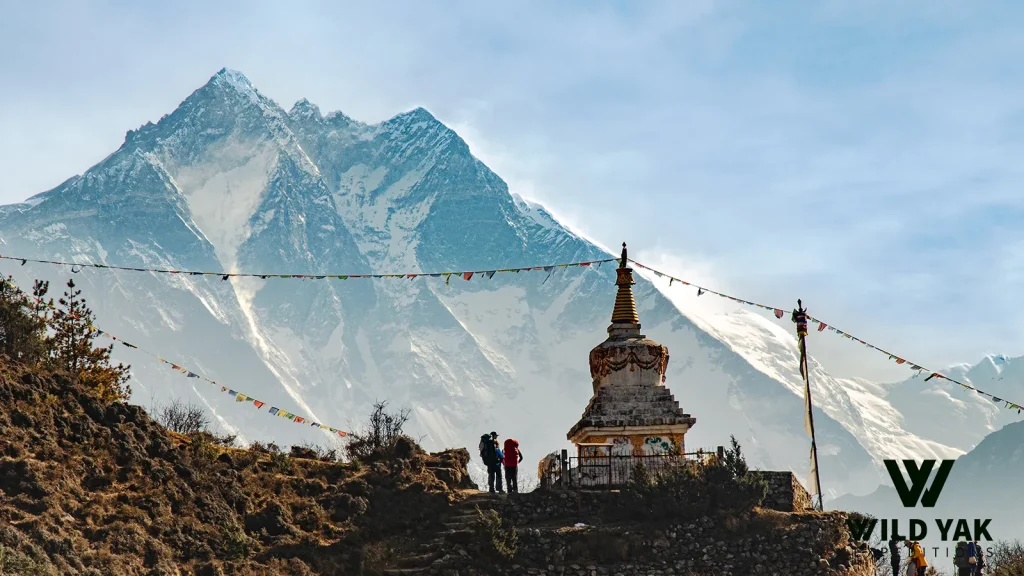
Without a Sherpa guide on your hiking tour, you would simply walk past many mani stones, chortens, and beautiful prayer wheels without knowing their significance. A Sherpa guide makes the environment come alive for you by showing you the culture of the valley:
- Always walk to the left of sacred structures so you pass them clockwise.
- Explaining the deep stories behind the bright wall paintings inside the Tengboche Monastery.
- Sharing real, personal stories of growing up and raising families in these isolated high-altitude villages.
This cultural immersion shifts your mindset. It turns a tough physical challenge into a rich personal experience, giving you a deeper sense of purpose when the trail gets incredibly steep and difficult.
6. Proactive, Professional Emergency Response
No matter how well you prepare, things can go wrong in the wilderness. When a medical issue or an unexpected storm hits, your Sherpa guide instantly steps up as a trained emergency coordinator.
At Wild Yak Expeditions, we don’t leave safety to chance. Our Sherpa teams operate under a strict system that pairs local mountain knowledge with high European safety protocols. Every guide carries a full medical kit, with oxygen and mask regulator, stays connected via satellite communication, and holds advanced certifications in Wilderness First Aid.
If a trekker gets too sick to continue, your Sherpa handles everything. Using their local contacts and language skills, they ensure a helicopter evacuation is quickly organized from Kathmandu, making all necessary arrangements for your transfer with absolutely no additional stress. The knowledge of having a professional organize your medical evacuation from such a remote location as Pheriche gives you an opportunity to concentrate completely on trekking. However, it is important to have valid travel and medical insurance.
Going Without a Professional Guide
Many trekkers focus on physical preparation, gear, and itinerary planning, but often underestimate the value of an experienced Sherpa guide. While both guided and unsupported treks follow the same trail, the experience can be dramatically different when it comes to acclimatization, health monitoring, pace management, and emergency response. The comparison below highlights how professional Sherpa support can improve both safety and overall trekking success.
According to the Himalayan Rescue Association, altitude sickness remains one of the most common medical challenges faced by trekkers above 3,000 meters in the Everest region.
| Real-World Scenario | Going Without a Professional Guide | Trekking with a Wild Yak Sherpa |
| High-Altitude Acclimatization | Sticking to a rigid schedule even when feeling sick | Changing the daily pace based on your body’s metrics |
| Daily Health Tracking | Waiting until you feel terribly ill to stop | Monitor your oxygen levels twice a day to spot issues early. |
| Emergency Situations | Scrambling to find cell service or help at a local lodge | Using dedicated satellite gear to call in a rescue helicopter instantly. |
| Pace control on Trails | Hiking too fast early on and running out of steam | Keeping a steady, slow rhythm to save your energy |
Why Wild Yak Expedition for Everest Base Camp
At Wild Yak Expeditions, we don’t look at mountain guiding as a standard tourism job. Our roots run deep here. Our co-founder, Norbu Sherpa, has stood on the summit of Mount Everest seven times and led dozens of successful 8,000-meter expeditions. Alongside Swiss mountaineer Andrea Sherpa-Zimmermann, we have blended rigid Swiss logistics with raw Himalayan experience.
We know that a great Sherpa guide isn’t just there to carry a heavy pack or point toward the path. They act as your physiological coach, your cultural link, and your safety net. Let’s look at exactly how their boots-on-the-ground expertise keeps you alive, healthy, and moving forward on the trail to Base Camp.
Conclusion: The Real Secret to the Khumbu
The journey to Everest Base Camp is so much more than checking off distances or counting up the elevation gains. It is a true test of your personal limits. Putting your trust in an experienced, highly compensated Sherpa guide isn’t about buying a luxury service; it’s about making sure you return home safely from a life-altering journey.
With their deep medical knowledge, quiet resilience, and profound respect for the mountains, the guides at Wild Yak Expeditions don’t just show you the path. They make it possible for you to stand at the bottom of the world’s highest peak and truly take it all in.
FAQs
- Is the EBC trek too hard for unathletic people?
Not if you can handle walking five to seven hours a day on rough, steep dirt. You don’t need to be a marathon runner, but having leg day or exercises before the trek is the best strategy to adapt easily.
- Can I just go out there alone without hiring a guide?
No, the local authorities changed the rules. Current trekking regulations may require trekkers to be accompanied by a licensed guide depending on the region and prevailing government policies. Travelers should verify the latest requirements before departure. You legally have to have a licensed guide with you to pass the checkpoints anyway.
- What actually happens if my lungs can’t handle the altitude?
You turn around and head down to a lower village immediately. If the guide checks your oxygen levels and spots signs of serious altitude sickness, they call in a rescue chopper on the spot.
- Are the tea houses and food actually decent up there?
The rooms are super basic, literally just plywood walls, two small beds, and a shared toilet. For food, expect lots of carbs like potatoes, garlic soup, and plates of dal bhat to keep you moving.
- When is the best weather window to clear my schedule?
Go between March and May to experience the active climbing camps, or hit the trail from September to November if you just want the crispest, clearest mountain views.


