


Written by Wild Yak Expeditions Editorial Team
The island peak in the heart of Nepal’s Khumbu is also known as Imja Tse by the local people. There is no doubt that it is the most famous of the high Himalayan mountaineering expeditions. The Island Peak, named so by the British climber Eric Shipton in 1952 after he found the summit, sits in the middle of the glaciers like an island, making part of the mythic Golden Age of Himalayan mountaineering. For climbers seeking to step beyond the limits of trekking and into the Alpine terrain, it’s the privilege par excellence to climb Island Peak for its blending of technical aspects and cultural significance.
Island Peak Altitude: Key Elevation Points
Understanding the island peak altitude at each stage helps climbers prepare their bodies and pace their ascent effectively before they climb Island Peak.
| Location | Altitude |
| Kathmandu | 1400 m / 4593 ft |
| Lukla | 2860 m / 9383 ft |
| Namche Bazaar | 3440 m / 11286 ft |
| Dingboche | 44100 m / 14470 ft |
| Chhukung | 4730 m / 15518 ft |
| Base Camp | 5087 m / 16690 ft |
| High Camp | 5600 m / 18373 ft |
| Summit | 6189 m / 20305 ft |
Oxygen levels at the summit drop to around 47% of the levels at sea level. In a study of patients presenting to the Mustang District Hospital in Nepal, those climbing too fast were twice as likely to be suffering severe altitude illness.
The Climb: The nature of the route
The normal route follows the southwest ridge from Chhukung valley. The summit day is 9 to 12 hours (return from High camp), beginning from midnight to 1 AM.
- Approach: A stony moraine between High Camp and Crampon Point (where you put on crampons and harness).
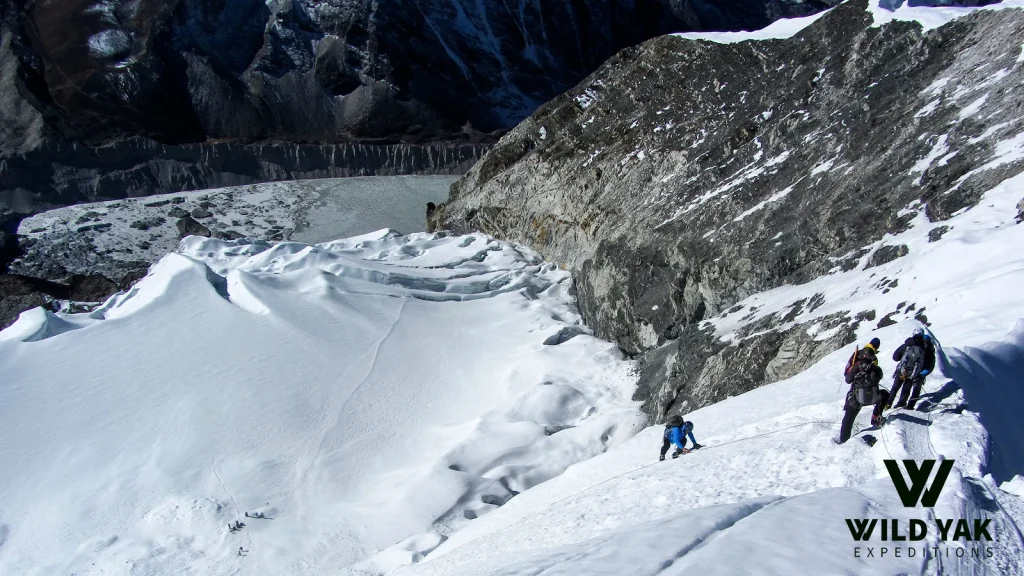
- The Traverse: Roped teams progress across the Imja Glacier. There are several crevasses that can be crossed by means of fixed metal ladders, erected by the Nepal Mountaineering Association in 2009.
- The Headwall: The crux. This is a 100m wall, climbing from 45 to 60 degrees up using a jumar on the fixed rope.
- The Ridge: A narrow, exposed, snow ridge that leads up to the small summit dome with views of Lhotse, Makalu, Baruntse, and Ama Dablam.
Safety Risks on Island Peak
All high-altitude expeditions carry risk. The main risks associated with Island Peak are the following:
- AMS: It is the most prevalent problem that one might encounter. Studies on Nepalese pilgrims reaching 4,380m recorded a 34% AMS occurrence; the major contributing factors were an increasing ascent rate and being over 35. At 6,189 meters, proper acclimatization days are non-negotiable for anyone to climb Island Peak.
- Crevasse Hazard: Hidden snow bridges on the glacier can give way without warning. All teams move roped together through this section.
- Headwall Fall Risk: The steep headwall and exposed summit ridge require focused rope technique. Guide-to-client ratio matters significantly here.
- Frostbite and Hypothermia: Temperatures at High Camp and on the headwall can reach -20°C. Proper high-altitude footwear and insulation are protective equipment, not optional comfort.
Real-Life Experience: Michaela and Magdalena
Magdalena and Michaela, from Germany, with Wild Yak Expeditions, climbed Island Peak in autumn 2023. Before climbing Island Peak, neither of them had any previous mountaineering experience at high elevations; however, they were both fit with extensive experience hiking long distances.
On the morning of summit day, Micheleala was having a persistent headache and had lost her appetite, which are both common symptoms of altitude sickness (AMS). Because of this, Wild Yak made the decision to provide her with 24 hours of rest in Chhukung, rather than proceeding to the summit of Island Peak. Michaela recovered completely, and they both returned to attempt their summit on Island Peak, enjoying views of Lhotse, Makalu, and Ama Dablam.
They said, “It was well organized according to our needs, and every step of our trip had safety in mind. We will soon plan our second trip to Nepal with WILD YAK EXPEDITIONS.”
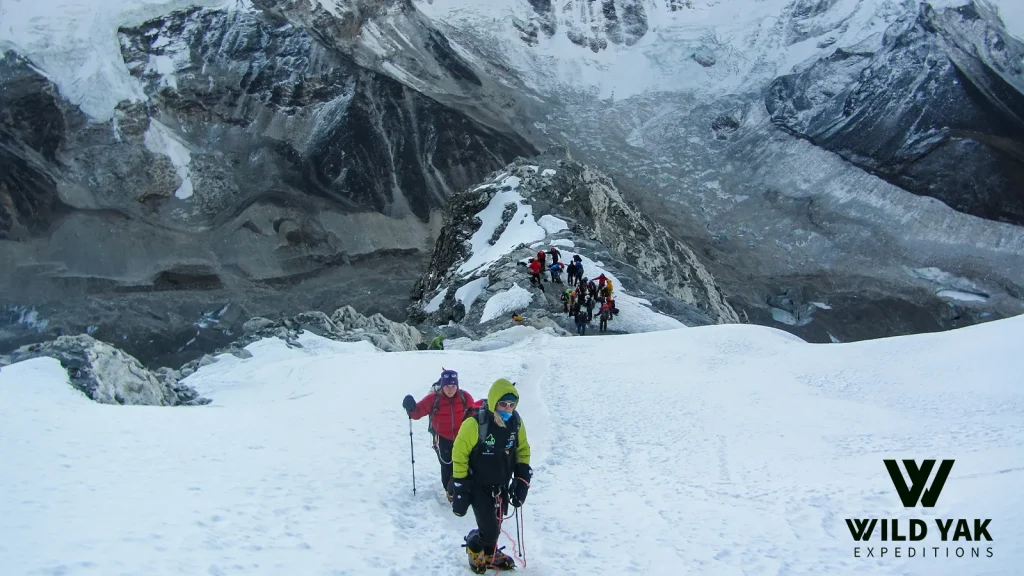
Most of the time, taking a safety day is the determining factor in completing a summit.
Success Rate: What Drives It Up or Down
Success rates for good climbers on an Island Peak expedition tend to be around 75 to 85% in suitable conditions.
Crucial factors that influence outcome:
- Previous altitude experience above 4000m leads to better acclimatization
- Good spacing and rest days are the most important factors in success
- Small groups and a good guide-to-climber ratio increase safety and better judgment.
- Spring and autumn climbing seasons provide the most suitable weather windows.
- Prior fitness preparation (specifically cardiovascular endurance) is highly relevant for summit day when attempting to climb Island Peak.
Fitness and Permits: A Quick Reference
- Fitness
Moderate++. While no mountaineering certificate is necessary, there is a prerequisite of cardio endurance needed for a 9- to 12-hour summit push. It is advisable to practice crampon and ice axe techniques before you leave.
- Permits required
- NMA Island Peak Climbing Permit: USD 350 in spring, USD 175 in autumn
- Sagarmatha National Park Entry Permit: approx. USD 30
- Khumbu Pasang Lhamu Rural Municipality Permit: approx. USD 20
Conclusion
Climbing Island Peak has to rate among the very finest summits for any first-time altitude mountaineer in the world. The altitude is real, the glacier cannot be underestimated, and the headwall really puts you through the wringer. The success rate accurately depicts the Island Peak climb for what it really is. It is all about an honest approach, an itinerary that respects the realities, and a team that values safety more than speed. Difficult, but possible, and good value for time and money.
Ready to climb Island Peak? Book your expedition today with Wild Yak Expeditions.
FAQs
- Can I climb Island Peak without any experience in climbing?
Yes, With the support of the climbing Sherpa Team. In fact, Island Peak is the most recommended Himalayan mountaineering for those who want to experience an expedition. But we highly suggest taking a basic mountaineering course or doing some climbing practice with the gear. Doing so will boost your confidence for Island Peak and increase your chances of reaching the summit.
- Is January appropriate for climbing Island Peak?
No, indeed, March to May or September to November are ideal months for Island Peak climbing.
- Is the guide mandatory for the Island Peak expedition?
Yes, you need to have a guide authorised by the NMA; without one, you won’t be able to obtain the climbing permit. As Island Peak is one of the most climbed peaks in Nepal, monitoring is strict by the authorised stakeholders.
- How many days should I plan for an island peak climb?
It is better to plan 20 days for the Island Peak expedition. Rushing to acclimatization may lead the climber to return earlier without successfully summiting.
- What is Island Peak altitude?
Situated in the Everest region of Nepal, it is 6,189 m (20,305 ft) above sea level.
- What kind of equipment and gear do I need to climb Island Peak?
All logistical equipment is provided by Wild Yak Expeditions, but you need to have personal climbing materials, such as a down jacket (-20), insulated pants, crampons, an ascender, a descender, a harness, 2 carabiners (auto-lock and screwgate), a helmet, a 1-metre climbing sling, and a climbing boot such as La Sportiva G2 Evo or Scarpa Phantom 6000.
Most of the equipment you can rent in Kathmandu, if you do not want to invest in it.
Authored and Validated By: Norbu Sherpa, Expedition Expert


